The morning started off chilly, but calm. By the time I reached Bay Campus the temperature had warmed and the winds remained still. It was looking like a perfect fall kayaking day. After much debate, I decided to wear just a long sleeve shirt. I stowed the paddle jacket in the rear hatch. I didn't want to overheat.
We headed out of Bay Campus towards the Dutch Island Lighthouse. From there we turned towards Beavertail. We were planning on playing on the rocks along the Jamestown shore before heading over to Narrow River to play in the surf. Then we were hoping to play in the rocks along Bonnet Shores on the way home. It was an ambitious plan.
As we passed the pavilion at Ft. Getty, we started to realize our plan may not come together. The forecasted 5 knot wind felt more like 15 knots. The wind was stronger near shore, so we tended to stay a little off the rocks.
As we approached Beavertail, the wind built. The sea state got bigger as well. By the time we got to the point, the wind felt like a sustained 20-25 knots.
Fortunately it was a headwind and not a beam wind. The Q-Boat slices through headwinds without a problem. Once the wind crosses her beam, she weather cocks like a bitch in heat.
Paddling into a steady, strong head wind is draining. I was draining my tank faster than usual due to a couple of things. I haven't been paddling as much this year, so my fitness level is lower than I'd like. I also made the unfortunate choice to leave my stick at home for the day. I was plowing into a brutal wind with a fat Lendal Kinetic Touring blade. I like the Lendal, but in the wind I love my stick.
I may have felt like I was running low on gas, but one of the other paddlers had reached the bottom of his tank. He was looking pale and open mouthed. We decided the best course of action was to put him under tow and tow him directly to Narragansett Beach. He was not given a choice, one of the paddlers hooked him up and started the tow.
We used an I tow to avoid wearing out any of the other paddlers. About half way through the crossing, we swapped towers. TM and I took the second shift. The wind made the long tow a particularly rough haul.
At the beach, the wind was roaring. I was wet from spray and sweating, so I quickly put on my paddle jacket. Once I was snugly in my paddle jacket, I settled in for a nice lunch. H had made me some yummy PB&J.
The return trip started off on sour note. I couldn't get the Q-Boat off the beach. The wind and chop were perfectly aligned to trap me on the beach. Every time I got the nose of the kayak in the water, a wave would push the bow around and I'd be breached on the beach. Eventually I got pushed off the edge of the beach into Narrow River. Once in the water I had to fight the wind and the currents to get turned around so I could paddle out to the open water. I was beat before I got started.
For the first quarter of the return trip the Q-Boat was getting pushed around something fierce. I couldn't seem to keep it under control. A swell would run by, loosen up the back end, and send the kayak off on a new course.
Eventually, I settled in and got things back under control. Once I was back in the groove, the return paddle was a fun ride. The tail wind and following seas made for a quick trip. There was even some opportunities for playing in the rocks.
Once we got back to the Bay Campus everyone piled out their kayaks and started changing. The water temp and the wind made the idea of doing rescue practice unpleasant.
We then headed off to our favorite java joint for some coffee and post paddle chatter. It was great to get out on the water - even if the conditions were less than ideal.
Showing posts with label rescue. Show all posts
Showing posts with label rescue. Show all posts
Sunday, October 11, 2009
It Blows Big

Saturday, September 20, 2008
Crossing Stone Bridge
We finally got a day where the currents and the weather lined up enough to give us some opportunity to play at Stone Bridge. H, who was feeling the effects of paddle withdrawal, even joined us.
TM planned the day so that we would get some calm water paddling in before lunch and then play for a little while in the afternoon.
The morning paddle was pleasant. We meandered our way north for a few miles. At the point where the Sakonnet River splits off into Mt. Hope Bay, we turned back for lunch. It was a nice way to warm up. The paddling was leisurely and the weather was perfect.
After lunch, we headed out to the race for some play. The current was pretty tame. H spent a little time getting a feel for moving water. A number of us tried to find some standing waves to surf. Sadly, there wasn't much there.
JS showed people a few good drills for doing eddy turns. The best was trying to cross the eddy line backwards. Most people took a swim trying it. What caught me up was the lean. My natural instinct is to lean the wrong way. The result is the edge gets caught in the current and over I went. Even when I tried to fix the proper lean direction in my mind before backing into the line, my first move was wrong. I had a hard time learning to drive in reverse too.....
Before heading back in, JS got most of us to practice our rolls in the current. Just about everyone managed to come back up.
Despite the mild conditions in the race, it was a fun day on the water. (Is there ever a bad day on the water?)
Sunday, July 13, 2008
Pushing It
Due to obligations, H and I could not join PB's Saturday paddle on the Westport River. I took the opportunity to zip the Q-Boat down to Carl Ladd's shop to get my leaky skeg patched up. Saturday in Westport was beautiful paddling weather.
Sunday was a little less ideal... It was colder, windier, grayer, and wavier. H and I arrived at Pier 5 to find people surfing just off the tip of the rocks. It was big and breaking. Beyond the break it looked much better. The swells were large, but smooth.
H immediately balked at the original float plan. TM, H, and myself were going to paddle from Pier 5 and head south towards Pt. Judith. This is a fun stretch of coast because of its exposure and because it offers places to get off the water in a pinch. Given the swell and the wind today, the route would be challenging.
After some discussion, the three of us decided that the wise plan was to head into the Bay and paddle out of Bay Campus. This plan would allow us to experience some of the swells and the challenging conditions, but would keep us a little more protected. It also had the advantage of being familiar to all three of us.
From Bay Campus we headed south along Bonnet Bluffs. The swells were 3-5 feet along the bluffs. It was a thrill to punch through them. There was also some opportunities to play in a few rocks...
TM and I were enjoying ourselves, but H was on the outside of her comfort zone. She was trooping through and pushing herself. About 3/4 of the way to Bonnet Cove, H wanted to change course. She'd had enough of battling the swells.
TM persuaded her that we should cross to Jamestown. Along the way he kept having H change course. First we'd paddle beam to the swells, then we'd turn and push into the swells, then we'd paddle beam to the swells, then we'd run up the Bay with following seas. It was not a crossing that could be done on a busy summer day with lots of boat traffic. Fortunately, the high gas prices and the weather kept that to a minimum.
We lunched on the Jamestown shore. H and I played with our new binoculars. We also contemplated our post-lunch paddle plan. I kept joking that we should head towards Beavertail. I knew, however, that we'd be heading back to Bay Campus. The big question was how direct the route was going to be.
TM, wisely, decided to follow our outbound route home. On the crossing, he played the same game of getting a feel for how the kayaks felt in the swells. Once back near the Bonnet shore, we turned up the Bay. The following seas pushed us home with some fun rides. I caught one that seemed to go for miles. It was one of those magical waves that just passes you on to its friend to keep the ride going. Even H caught a few good rides. Her Capella is excellent in following seas.
Once back at Bay Campus, we decided to a little rescue practice. H said she would do one rescue... So we took her out beyond the moorings, where the swells could be felt. As we were paddling out she looked over and hissed "Why do you make me suffer like this..."
Once we were settled squarely in swellville, I flipped over and became the rescue subject. H moved into position quickly, but couldn't quite get the kayaks to form a T. So, she backed off and kept trying to make the T. After a few tries, she got a hold of my kayak and did a great rescue. Despite the difficulty of holding on to a kayak in the swells she did an awesome job. She drained the water out of the cockpit and held the kayak steady while I climbed in the cockpit.
After H's rescue, it was my turn to do a rescue. TM dumped out of his kayak, and I moved in to position. Not being a stickler for form, I slipped in parallel to his kayak and then worried about getting the kayaks into a T. Then I did the rescue. I have a huge advantage in this over H - 100lbs and a lot of upper body strength.
TM and I then did a few rough water rolls and called it a day.
It was nice to get out and paddle in some rougher conditions. It was also nice to see H push herself. She is a much better paddler than she gives herself credit for being.
Rough water paddling is not for every paddler, nor is it for every paddle. However, it is good to experience occasionally. The ocean is a fickle mistress....
Sunday, June 22, 2008
The First Flip
After missing a weekend of prime paddling weather, H and I were ready for a serious paddle. TM's paddle out of Ft. Wetherill looked primed to offer conditions that would meet both H and my ideas of serious. Launching from Ft. Wetherill gives you plenty of options for a trip, but they all involve the potential for playing in the rocks, open water, big swells... Today there was also the possibility of fog and thunder showers.
The crew also offered opportunities to meet a wide range of paddle needs. We had surf/rock heads like RS and TM to the more conservative H and S. In between the extremes we had CC, TM, RR, RB, BH, T, and myself. It was a group ready to face any possible conditions.
TM's original plan was to paddle down to Beavertail, cross the West Passage, and lunch at Narragansett Beach. This plan was ruled out due the morning fog and the predicted thunder showers. Instead, we decided to cross over to Newport and play along the Newport Coast and lunch near Kings Beach. This path gave us more cover in the event we needed to get off the water in a hurry and a better shot at finding interesting conditions.
Going out we found the water to be relatively flat. There was barely enough action along to coast to make playing the rocks risky.
At Brenton Point, there was a little more action. People managed to catch a few good rides. For Brenton Point, it was dead.
The paddling was fun if not exciting. There was enough action to keep you on your toes. The sun was shining. The company was good.
We lunched next to Kings Beach fishing landing. While part of the group was settling in for lunch, BH, TM, RS, and I explored the rocky point just beyond the fishing area. We paddled through a narrow channel and saw some very cute baby seagulls. When we reached the point, we found the excitement.
TM timed his run perfectly and used the waves to avoid being stranded on the rocks. RS's timing was a little off and she was confronted with an unfriendly wave. It was no match for her skill and she scooted through. BH decided discretion was the better part of valor and took the point wide. I lucked out and slipped through between waves.
After lunch, we decided to just head back to the put-in. We figured it would be a relaxing, uneventful paddle back to the cars...
Minutes after I was off the beach, I spotted H in an area with breaking waves. I was hoping she'd luck out and slip by without issue, but a wave popped up right next to her and crashed down on her. From where I was sitting, it looked like she tried to brace, but the wave was too big. She took her first combat spill.
I was a little worried that she would panic, but confident that she would be fine.
Sure enough, she popped right out and never lost her paddle.
RR moved in for a rescue, but got flipped by a wave. RS then swooped in and took control of the situation. She clipped into H's kayak and started towing her out of the breaking waves. She also made sure someone was looking out for RR.
As it turned out RR was fine. He rolled back up without a hitch.
As RS was towing H to flatter water, I paddle up and made sure H was OK. H had stuck her paddle in her cockpit and it was flopping around. To make sure it was secure I stowed it under my deck lines. Unsure what RS's plan was, I backed off since the situation seemed under control.
TM then swooped in to put H back into her kayak. He unclipped H's kayak from the tow and clipped his kayak into the tow. Then he started performing a T rescue. Since the water was still pretty bouncy, I rafted up to lend some extra support.
H climbed into her kayak and was ready to go. Aside from a few bruises, she was none the worse for the wear. She was quite pleased with how well the rescue had gone. She was a little shaken, but also felt more confident in her ability to survive a mishap.
The rest of the paddle was pretty tame. We found a little surf at Brenton Point. The crossing from Castle Hill to Fort Wetherill offered up some following seas.
We had one more moment of excitement in the cove at Fort Wetherill. RB tried to run a slot on one of the rock outcroppings at the mouth of the cove and got stuck. After some comical flailing, he washed right off.
As part of the post paddle play session, I squeezed myself into H's Capella 161. It is a sweet little kayak. It is fast and turns much easier than the Q-Boat. I may need to take it rock gardening some time....
Sunday, October 28, 2007
When Level Two Trips Go Bad
H wanted to get at least one more paddle in this season, so I posted a level two trip heading from Bay Campus to Rome Point. The distance was pushing the upper limit of a strict level two, but still within the cutoff. Joe, looking for a more adventurous outing decided that he'd run a level three from the Bay Campus as well.
The winds were whipping when we arrived at Bay Campus and they were forecasted to stay steady throughout the day. At the put-in we briefly discussed moving the paddle to Tuckertown Pond to gain shelter from the wind. For a strict level two paddle we should have moved to the pond, because the winds were definitely over the prescribed limit. However, the assembled group (H, CC, BH, PB, LB, TM, and DV) were all capable level three paddlers and voted to stay on the Bay. We would paddle close to the shore to stay as protected from the wind as possible and slowly fight our way into the wind up to Rome Point.
Joe's plan was to cross over to Jamestown and paddle into the wind. He, JS, and Larry set off ahead of the level two group.
As I was gathering my gear, H noticed that I was leaving my tow-belt in the car.
"You really should take that," she pointed out.
"But its just a level two paddle, I'm not going to need to tow anybody," I protested.
"Still," she said with a disappointed look.
I put the tow-belt on. Somehow, the tow-belt incident through me off and it took me forever to get on the water. I could hear the group collectively tapping their toes waiting for me.
I finally got on the water and, along with TM, proceeded to hug the shore going north. The rest of the group paddled outside of the mooring fields. The combination of the wind protection we gained from being near shore and our native paddling speed opened up a wide gap between us and the rest of the group. We held up and the rest of the group caught up and joined us closer to the shore.
As we moved up the coast toward the bridge we had to monitor our individual progress according to the group as a whole. The wind exacerbates the problems of keeping a group together and increases the importance of keeping the group together. The wind makes slower paddlers slower, makes faster paddlers less likely to look behind them, and makes communication even more difficult.
About 3/4 of the way to the Jamestown Bridge, we spotted two kayaks crossing the channel from Jamestown to the mainland shore. It looked like Joe and JS, but we didn't think it could be them. They left the beach as a threesome that included Larry. Once they approached we learned that Larry had turned back and they had let him go it alone. Without knowing any of the details, we all immediately questioned the soundness of the call. It was not how we usually operate and it was definitely out of character for Joe. He typically works very hard to keep the group together.
(As I found out later, the whole thing was the result of a breakdown in communication. Larry had fallen behind and decided to turn back. He told JS, who was fishing, and split. By the time JS had rejoined Joe and communicated Larry's decision, it was too late to do anything. Larry was either safely back on the beach or being blown out to sea.)
I stopped the group just before we reached the bridge to see how people felt. There was a reasonably protected beach for lunch or resting, so if the group was looking to rest it was a perfect spot. I was also thinking that it would be good turn around point instead of going all the way to Rome Point.
Paddling under the bridge is always tricky because things get choppy and the wind is funneled straight under the bridge. Once under the bridge, we'd loose any wind protection until we reached Rome Point. H hadn't been in her kayak much this fall. DV was paddling an unfamiliar kayak. The wind was more than any of us had anticipated.
I could have simply called lunch. This was a level two paddle and we were already beyond level two conditions. I could have also decided that since we were already in level three conditions, we would complete the mission and paddle straight to Rome Point. Instead, I opted for taking a vote. As with the vote on the beach, nobody had a strong opinion, but generally felt like sticking to the original plan.
So, we continued onward.
Once under the bridge, the wind slammed into us. It didn't take long for people to get worn down. About halfway between the bridge and Rome Point, DV asked if we could stop. His back was beginning to bother him and he didn't want to push it much more. Others were happy to oblige. Someone did mention that Rome Point was just a little further. The group, however, stopped for lunch and decided that from lunch we'd head back to Bay Campus.
Joe and JS once again split with the group after lunch. They planned to head up to Rome Point and see if they could find any more fish.
The rest of us got on the water in pods. While people were launching I paddled up to TM and said "lighthouse" and he smiled. From the shore it didn't look like the conditions over by the lighthouse were bad. If either of us had used our brains, we'd have known what it was really like between us and the lighthouse - unpredictable, big chop, and a strong, beamy wind.
H was one of the last people on the water and I rafted up with her to mop some of the water out of the Q-Boat. While we were drying out my cockpit, the rest of the group headed out to the lighthouse....
After I got the water out of the Q-Boat, H and I turned to rejoin the group or what was left of it. I could see a pod of kayaks about halfway to the lighthouse and few other kayaks closer to the lighthouse. Since I thought the group was going to the lighthouse, we pushed down along the bridge. Conditions were what H calls the "washing machine". The chop was big and coming from all directions. It was not ideal, but neither was getting separated from the group. I insisted on rejoining the group since we could manage the chop.
H, on the other hand, wanted to slip under the bridge and get out of the chop. She spotted half of the group on the southern side of the bridge parked near the shore. She repeatedly tried telling me about the others.
I could not hear her, so I continued pushing towards the lighthouse and the kayaks I could see.
Finally, she caught my attention and pointed out the rest the group. Once I saw that there was part of the group in calm water, I knew the right thing to do. We turned and paddled under the bridge.
There was still a scattered group out in the center of the channel, so I wanted to make sure they were OK. My first priority, however, was getting H to the safety of the group. She, however, had also seen the stray group and noticed that one of the kayaks was capsized.
"There is someone in the water," she told me. "I'm fine, you go help."
I raced out the rescue sight. TM was heading over to a nearby fishing boat to ask them for assistance. BH had a hold of DV and his capsized kayak. PB was stabilizing BH. There were paddles floating all over the place.
I collected the paddles while BH attempted to put DV back in his kayak. The conditions were making the rescue hard and DV was making it even harder. He didn't seem to have the strength to get himself back in the kayak. At one point he just quit and wanted to get a ride home in the nearby fishing boat. Eventually, after TM and BH told him it would be harder to get him into the fishing boat, he managed to get back in his kayak.
Since he had so much trouble getting in the kayak, we decided that it would be best if DV was towed for awhile. BH, since he was already stabilizing DV's kayak, would stabilize DV while under tow.
Since I had my tow belt on and was in the best position, I hooked the two kayaks up - I snaked my tow line under the BH's inside dock line, then under the inside of DV's front deck line, and then hooked the tow line together to make a lasso. Towing two kayaks is a bitch. At first I wasn't sure I could get enough power using the mighty stick and considered asking TM to get my spare Lendal off my back deck. However, I didn't relish the idea of starting from a dead stop again. Once I got a rhythm going, things got easier. Then PB, who had borrowed BH's tow belt, hooked onto the front of the Q-Boat. That made towing much easier.
After what seemed like an eternity, we got close to the shore and managed to catch up with the rest of the group. DV was feeling better, so we dismanteled the tow. Once free of the tow, DV took off for home. TM, who may have been the only one capable of matching his pace, followed. H decided to stick with TM as a back-up.
The rest of us wended our way back to Bay Campus and prepared for what promised to be a serious debriefing. CC was upset that we had even tried to paddle to the lighthouse given the conditions. LB was upset that she had been left alone for a period of time in the rough water. H was upset that I had made her attempt to paddle into the middle of the channel. The boys were upset because we had made some bad judgment calls. Everyone was upset that Larry's fate was unknown.
Once safely on the Bay Campus beach, we debriefed. Post-paddle debriefs are one of the best learning experiences and this one was no different. Nothing got solved and no blame was laid. We did learn that communication needs to be better, that level two trips need a strong hand when it comes to making decisions about when to stop, that your group is only as strong as its weakest paddler, and that when conditions are tough everything is harder and more important. Maybe benevolent dictatorship is not always a bad idea...
Fortunately, everyone ended the day healthy and wiser. A bad day on the water is better than a good day at the office....
Saturday, October 27, 2007
Return to Old Stone Bridge
The lunar cycle is 29.53059 days which means that every 30 days the moon is full. For those nautically inclined, it also means the bigger than average tides happen every 30 days. Big tides equals big tidal currents.
The full moon was Friday the 26th, so the currents at Old Stone Bridge promised to be fast on Saturday the 27th. I posted a practice session and bristled with anticipation for the chance to play. As Saturday approached, the weather aligned with the currents to ensure a maelstrom.
It was rainy and windy when I showed up to a flooded put-in. The channel was already looking lumpy and the real action was more than an hour away. I wandered up to Coastal Roasters to get a coffee and wait for the rest of the brave (foolish) paddlers to arrive.
We got an excellent turn-out. There were eight kayaks and eight paddlers. Three of the paddlers were new to the group (Gerry, Rich, and Larry) while the balance of the group were RICKA regulars (TM, PB, PH, CR). The pre-paddle preparations included a talk by TM about being ready to rescue people. It also included TM asking me if I was going to wear a helmet. I was not because I figured there were no rocks around to squish my mellon. TM's question, however, made me rethink my plan and I plopped the helmet on my mellon.
We spent a little time near the beach getting loosened up and sizing up the maelstrom in the channel. It was perfect. The winds was blowing up river as the water rushed down river. Waves boiled up at irregular intervals. The eddy lines were clear and full of whirlpools. The bad weather kept the fisherman to minimum so the area was clear of fishing lines.
It didn't take long before the group drifted into the thick of things. We spread out across area. TM wanted to spend time practicing boat handling skills in the eddies. The Ps wanted to dive right into the standing waves. I wanted to work on boat handling skills in the the maelstrom. The others all found there own spot to work. The area was dynamic. You could be sitting in relatively calm water just on the edge of the really big stuff. It was easy to slip out to get a quick breather. It was easy to slide along the side and slip into the really big stuff. There was a section in the center that would flatten out and offer a rest every so often.
It didn't take long before somebody went in the drink. Larry was playing near the evil bouy and flipped. I was in the center of the channel about 10 yards away, so I turned to make the rescue. I edge the Q-Boat a little too much, however, and also flipped. I set up my roll facing down stream and popped up with too much ease. I went over the other side. I set up my roll on the upstream side and came up just enough to get some air. It felt like the Poseidon grabbed the might stick and pulled it under. I pulled the loop and became a second swimmer.
Gerry was on me in a flash. He made sure I was OK, assessed the situation, and decided to tow me into calmer water before trying to put me back in the kayak. He latched on the Q-Boat's bow and starting towing the upside down kayak closer to the beach. It was a struggle because kayaks are not designed to travel through the water upside down... Once I was in calmer water, TM did a t-rescue to put me back in the kayak. The water was rough enough, the I managed to bounce my helmeted mellon off the Q-Boat's hull and TM's hull a few times.
Hardly shaken, I rushed back into the fray. Before long, I got to repay the rescue. Rich went over and I was in perfect position to rescue him. I decided that the water was calm enough to do the rescue. The boiling water and standing waves made it tough to get a good grip on Rich's kayak, but once I had it firmly in hand the rescue went smoothly. It was not text book, but it was successful.
Paddling in those types of conditions is tiring and we decided to take a break after about an hour. We drank some water, ate some snacks, and drained the water out of our cockpits. We also got a chuckle TM trying to squeeze into Rich's Nordkapp LV. TM's memory of the Devil Boat needed a little refreshing. Fortunately for all of us, TM couldn't squeeze in to the cockpit. We would have spent the rest of the morning pulling TM out of the drink...
After the break, I decided to spend some time experiencing the eddies. They were very clearly defined and pocked with whirlpools. I practiced crossing the eddy line without getting completely turned around. It was a challenge trying to figure out which combination of strokes and edging worked most effectively. I tried sweep strokes to counter the initial punch of on the bow, followed by a stern rudder to straighten out. It was only partially effective. I tried starting with a stern rudder, but that failed completely. The trouble was countering the initial punch to the bow. The force of the current rushing downstream wanted to push the bow downstream with and the stern of the Q-Boat offered little resistance. In the end, all that really seamed to work was finding the best angle to attack the line and digging the edge in to arrest the turn.
The whirlpools were fun. I'd stick my bow into the edge and it would push the nose around and a well timed switch to the other edge of the hull would keep the spin going through the full 360. The centers of the whirlpool looked mean. They dropped a good foot or two, and, while I'm sure they didn't have the force needed to suck the Q-Boat to a watery grave, I was not about to go sticking my bow in their to find out.
After playing in the eddies, I wanted to get back out into the boil. I slipped across the eddy line, go tmy bow pointed back up stream, and let the current suck me down between the cans. Once there I worked on holding my position and playing on the waves. It was fun until I found myself upside down. Disoriented, I set up my roll on the upstream side. It was like moving through gello and I barely got enough air to catch a breath. I slipped back under the water laying on the back deck. I felt a little panicky and just grabbed for the loop.
Needing to be rescued twice in one day didn't sit well with me. I felt like I hadn't kept my center when I most needed to keep it. After a short rest, I set out to practice rolling in the midst of the maelstrom. I was going to master the situation even if mastery meant swimming. I enlisted PB to spot me and headed back up the flow.
Along the way, PH hopped in front of me trying catch a few good rides. I found myself sitting next to him in one of the random calm spots until the boiling started. PH went over and tried to roll. Before I could get over to him, a wave picked me up and shot me forward. Fortunately, PB and several of the other paddlers were right behind us.
A smart paddler would have waited for his support to regroup before attempting to roll in conditions that had resulted in two previous rescues. I'm not always smart. I flipped myself over, made sure I set up downstream, and rolled upright. Not happy with just one, I did it again. And again. Then I set up parallel to the current and rolled up. Still not satisfied, I set up facing upstream and struggled back upright. To prove to myself that it was not a fluke, I went over again and set up facing upstream. When I finished the roll with my head still in the water, I felt the panic start and let it wash through me. Then I switched sides and rolled into the sweet air.
It was time to end the madness and land the kayak. I had regained my confidence. I had pushed my luck enough. I was exhausted. Everyone else was heading in as well.
We'd only been on the water for three hours, according PB's GPS, we'd only traveled about four miles, and we'd gained a incalculable amounts of experience. Getting a feel for confusing conditions, waves, and currents in a controlled area with a good group is a rare pleasure. The rescues made the day even better. Knowing that the others in the group can catch you if you fall boosts your confidence to push the limits and grow.
Sunday, August 26, 2007
Westport Warm-Up
After five days of paddling, I was ready for a rest. All I wanted to do this weekend was help out a friend with his charity bike ride and do some yard work. Paddling was not even on the radar. (No, I am not lying about this.)
So when H mentioned that she was surprised I wasn't paddling on Sunday, I was confused. There was no paddle scheduled for Sunday and I was not really up for paddling. Then she told me TM had posted a Westport River paddle and that helmets were recommended.... Still, I was doing a big bike ride on Saturday and I had just done a ton of paddling over the last week. But, it was the Westport river, the currents were looking promising, and TM recommended helmets....
Sunday morning I showed up at the Westport River boat launch a little stiff, but ready to play. If we timed things right we'd hit the mouth of the river at max current and still have time to head out of the river and find some surf.
We hit the water around 10:15 with a group of six stalwart sailors: TM, PB, RB (no relation), CC, RR, and myself. Unlike the previous weekend, the wind was calm and we made short work of paddling to the mouth.
At the river mouth we found a pleasant spot along the breakwater to play. In the middle of the channel, the current was running nicely. Along the edge of the breakwater, a nice eddy had formed. We could play in the current and use the eddy to rest and reposition. The eddy also made a nice spot for a safety person.
The sweet spot for me was the spot where the river passed the breakwater. The incoming swells added a little bounce to the equation and put me in position to watch the other paddlers. The spot's only drawback was that incoming boat traffic liked to pass through it.
We were careful to give the powerboat traffic plenty of room. The power boats also did their best to avoid us. Some of the bigger boats were kind enough to supply some wake waves to the mix.
During lunch RB, PB, and I did some kayak tryouts. RB is thinking about an upgrade from his Wilderness Systems kayak; PB wanted to give the Q-boat a whirl, and I wanted to take TM's new Explorer HV for ride. RB tried out both the explorer and the Q-boat and liked them both. PB didn't like the way the Q-boat rolled. I found the the Explorer HV to be pleasant enough, but way too big for me. It is very hard to get a good feel for any kayak on flat water and after only a few minutes.
After lunch, we headed out of the river. The current had died down and we wanted to see if we could find some surf or rocks in which to play. There is always something to play in along the coast.
Just outside the river we found a nice rock clump. It had a few different slots provided fun runs in the moderate swells. Everyone got a few good rides. I wasn't feeling 100%, so I spent a lot of time hanging back as a safety. It was hardly boring for me. It gave me time to practice some boat control skills and sometimes holding a position is more challenging than running a rock slot.
TM's back was bothering him, so we turned back towards home after about 20 minutes. The trip back into the river should have been uneventful. The swells were tiny, the current was minimal, and the boat traffic was non-existent. The only place where trouble could be found was close into the sea wall. Just off of its tip some waves were breaking and it looked like you could catch a nice ride into the river. Looks can be deceiving...
PB started to catch a wave, felt his nose get pulled towards the rocks, and backed off. I started to catch a wave, but was not really in position to catch a good ride. CC was just inside of me and was in a perfect position to catch the wave. She got a great ride, but was pushed in behind the sea wall. Realizing that she was between breaking waves and hard spot, she started to back paddle away from the sea wall. She made it over one breaking wave, but the second one flipped her. (Somebody needed to play the role of Bubbles in this paddle.)
PB was in a perfect spot to rush in and stabilize CC's kayak. I took a few seconds to spin the Q-boat around to get into position. Meanwhile CC realized she could stand-up and stabilize her own kayak. She just needed one of us to hold it while she hopped back into the cockpit.
Safely back inside the river, we all tried out our rolling skills. CC wanted to see the continuos storm roll I had learned in the Greenland course the weekend before. Although I was not confident I could even do a regular roll, I gave it a shot. I rolled right back up and CC gave it less successful try. She even tried it with a stick. RR and RB both showed off nice balance braces. PB's rolling luck had been jinxed by his earlier miss in the Q-boat. Rolls are delicate and fickle creatures. Like an Italian sports car or a great writer, a roll can be spooked by a spec of dust or a drinking the wrong water.
We retired for good chat and great coffee at Coastal Roasters. TM laid out his plans for tackling some bigger currents and rougher conditions over the next month or so. This was just a warm up. He wants to take on Stone Bridge at max current and maybe take run out to the Race....
Sunday, June 17, 2007
It started off so calm....
The outer west passage is a classic Naragansett Bay sea kayaking trip. It offers a gamut of conditions without too much exposure. It is long, but doesn't require months of training or risking blisters. There are two crossings and plenty of coastline with varying amounts of tidal effects and rocks.
Todays weather was sunny, warm, and just a touch breezy. It seemed like a perfect day for perusing the Jamestown coast and trying to catch some sun bathers with their pants down. At least at before 9am. Did I mention that I'm not so good in the morning?
So we set off from the Bay Campus beach 13 kayaks strong. The crossing to Ft. Getty was uneventful and we turned our sights on Beavertail. RS, Bubbles, and I decided to hug the shore while the main part of the fleet kept to the middle of the Bay. It was high tide so most of the pocket beaches were submerged, but there were still plenty of rocky outcrops to explore.
About halfway to Beavertail, the wind picked up and the swells got a little higher. It made things more interesting while we were close to the shore and not too close to Beavertail. However, it meant that getting past Beavertail and crossing to Whale Rock could be unnerving to a few of the paddlers in the group.
Wisely, TM decided to break for Whale Rock before we got to Beavertail. This saved us from navigating the rough water that hangs around the oceanic tip of Jamestown. It also bought a little more protection for the crossing. When crossing from the channel marker off of Beavertail to Whale Rock, you are at the mouth of the Bay and the swells have their full force. Just a few hundred yards inside the Bay, the swells lose a little of their power.
The crossing was a nice chance to experience open ocean conditions. We paddled into the 2' swells and stayed in a tight group.
Once at Whale rock we turned back towards Bay Campus and our lunch spot at Anawan. This meant following seas. A lot of paddlers find following seas unnerving and difficult to manage. Following seas tend to push your kayak around and you cannot see the waves coming at you to make adjustments. Others find them to be a great chance to catch some rides. With the Q-boat following seas are both a challenge and a thrill. Because the stern of the Q-boat is so low volume the swells approaching from the back have their way with the stern like a monkey with a banana. The Q-boat's stability and maneuverability, however, means that I can exert enough directional control to enjoy the rides.
As we turned into Bonnet cove, DV was caught off guard and capsized. H was the first kayak in and was already to do the rescue, but I tried to help out by rafting up with her before should got a solid grip on DV's bow. Fortunately, TM slipped into position and started the rescue. TM got the kayak empty in no time and stabilized the kayak so DV could reenter. The reentry did not go smoothly. DV nearly managed to drag TM, who was paddling his Aquilla, into the water. RB spotted what was happening and pulled up next to TM to stabilize TM. I pulled up next to DV's kayak and helped stabilize it. With a four kayak raft, we managed to get DV back into his kayak and back on his way to lunch.
The Anawan side of Bonnet Cove offers some choice rock formations to play in and the conditions were so mild I couldn't resist. I saw a nice slot that ran between two rocks, emptied out behind a low ledge, and had a nice wide path back to open water on the far side. The predominant swell pattern was a large number of small swells followed by a smaller number of large swells. It looked like we were in the middle of a set of small swells, so I slipped into position to catch a ride. I caught a moderate sized swell, rode it through the slot, and made a smooth turn to avoid hitting the shore. I then turned towards the open water.
Just as I started to make my way out, Bubbles set up to follow me. I could see the large swell starting out just as he moved into line with the slot. By the time he saw how big the swell was, it was on top of him and he was in the middle of the slot. I heard his cry of elation/panic and saw the yellow belly of his Pintail flip into the rocks. I was sure Bubbles was going to come up unconscious and bleeding. Bubbles has nine lives and popped up holding his kayak. As he tried to pull his kayak closer to shore and get it under control, I worked to get into position to through him a tow line so that I could tow him and his kayak out of the rocks.
We were in the middle of a set of big swells. Bubbles couldn't really get his kayak stable. Every time I got close enough to toss a line, I had to dodge a big swell to keep myself off of the rocks. TM also came in to help out. Three kayaks in a small space being tossed around by big swells is not an ideal situation. At one point TM was pinned between the Q-boat and the rocks as a big swell rolled through the area. Fortunately, I managed to move just enough and TM is a master of kayak maneuvering.
Eventually the swells calmed and we were able to tow Bubbles and his kayak out of the rocks. We then put him on his kayak and went to lunch.
The post lunch paddle plan was to enjoy a nice, relaxed paddle back along the bluffs to Bay Campus and then do some practice...
After a lunch, and making sure Bubbles was OK, we decided to paddle a little further into Bonnet Cove before breaking for Bay Campus. There are several tempting rock outcroppings along the edge of the cove. One fjord-like outcropping caught my, and Bubbles', eye. I checked the swells and decided to check it out. Bubbles followed closely on my tail. As soon as we got up close to the rocks, the swells grew and decided we need to be on the rocks... This time, both of us managed to dig our paddles in, keep ourselves off the rocks, and get back to open water.
It was a definite sign and both of us decided we'd had enough of the rocks for the day. I had no desire to split my new mighty stick on its second outing. It has to last at least until after the wedding...
The paddle along the bluffs was uneventful and the group spread out as they paddled back to the put in. As I neared the Endeavor's dock I realized that I could no longer hear TM and CC talking in the rear of the group. I stopped and looked to make sure they were OK. After a quick double-take I realized that I only saw one set of blades moving, so I paddled back to them. CC was giving TM a contact tow to get some practice.
By the time the three of us got back to the put-in several people were already off the water and either sunning or packing up to go home. A few people stayed on the water to practice, including myself. It was too nice to lay about on the beach.
However, all good things must come to an end.
Sunday, May 27, 2007
Pot Luck Rescues
Every year RIC/KA sea kayaking does a safety and rescue practice session early in the season. It is a good chance for regular members to polish up on their skills and for newer members to learn how rescues go in a group. TM usually takes the lead in running the group through its paces.
This year we had a good group show up and got some decent practice doing the basic assisted rescues. Most of the morning rescues were variations on the basic T-rescue. We practiced with the kayaks bow to stern, bow to bow, having the victim hang on the bow of the rescue kayak, and a couple of other variations. TM stressed a few things:
- The rescuer needs to make and maintain eye contact with the victim.
- The victim needs to be an active participant in the rescue if possible.
- All participants in the rescue need to consider the welfare of the paddlers not participating in the rescue.
We even did a few eskimo rescues, but TM stressed his opinion that eskimo rescues are rarely useful outside of spotting during rolling practice. In fact, he pointed out that they can be dangerous if the victim is not expecting it. A kayak bow on the knoggin is a sure way to ruin someone's day.
On the way back to the parking lot for lunch, TM and I split from the group to sneak a peak at the infamous breechway. It was flatter than a pint of beer after a night on the porch. Still, we found a few waves to play in before the second wave showed up and castigated us for not inviting them. I received special chastening for making off with H's lunch.
After lunch we practiced towing. We did some contact towing which is good for short distances. While passing PB back his short tow, I dropped it in the water. Since it was shallow and the rope was easy to see, I decided I could just roll over and pick it up... So, I grabbed onto the bow of PB's kayak, flipped over, and grabbed the rope. Getting back up proved to be a real trick. I had PB's bow with the wrong hand and could not get my body all the way around. Just as I was about to drop under and switch hands, another bow showed up and provided me a handy platform.
While practicing long tows, I handed off my tow rope to H and proceeded to drop the carabiniere into the water. It was not easy to see, so I was saved from even thinking about trying to rescue it.
We ended the water portion of the day with my demonstrating the rat swim. The rat swim is where you stay in the cockpit of the kayak and claw yourself to the surface to get quick gasps of air. It is uncomfortable and tiring, but if the water is cold and there are other people nearby it saves you from a bit of exposure.
After paddling, we retired to Christie's house for a pot luck. Everyone brought excellent food and it was nice to sit around and catch up.
Tuesday, December 12, 2006
Rescue Review
It is important to digest and dissect rescues. They offer great learning experiences.
The trip last Sunday offered a number of lessons.
Lesson 1: Eric Tries to Rescue Bob and Ends up Getting Rescued
I am not certain my decision to go in after Bob was the soundest decision I could have made. I say that after having been smashed, but even before that it was a questionable decision. I wasn't feeling at my best after being off the water for a few weeks, out of the Q-boat for a solid month, and not having paddled in anything more serious challenging than a salt pond for nearly six weeks. In the moment, with the adrenaline running, I felt I could do the rescue. The wave that squished me was pretty extreme.
Paul's rescue was flawless. He talked to me enough to determine I was OK, but not too long to delay the rescue. He quickly assessed the situation, made the plan clear to me, and executed the rescue. His call to toss me a line and tow me to safety was excellent. The conditions where the rescue started were big, steep swells that made maneuvering tricky. Paul's kayak could easily have whacked me if he had attempted to secure my kayak. Once he had towed me out of the rocks and swell, it was much easier to put me back in my kayak. Fortunately, I was properly dressed for being in the water and the few extra minutes were not critical. Even if I had not been properly dressed for immersion, Paul's choice to tow me out was probably still the right one. Trying to do the rescue in the swells could have taken longer or resulted in Paul's going into the drink also.
Lesson 2: Bob Plays in the Rocks and Takes a Swim
One could say that Bob should have had the sense to stay out of the rocks given the conditions. However, that was Bob's call to make. If he honestly believed he was a match for the conditions, he cannot be faulted for looking for some fun.
What happened once Bob got squished is ripe for analysis. We did some after the paddle and I have been thinking about it since. After I was dumped, Matt moved into help Bob. I'm not sure what happened while I was being rescued, but I know that Bob, his kayak, and Matt were still being bounced around in the rocks after I was safely back in my kayak. From what I heard, Bob had found his way out of the water and onto the relative safety of some rocks and was trying to drag his kayak up with him. Meanwhile, Matt was sitting just off the rocks to help. After a few minutes, Bob managed to get his kayak on the rocks with him and drag it to a section of water that was protected enough to allow or a launch.
While everything turned out OK, the whole thing took too long and left at least one kayak in needless danger. Based on what I heard, I think the root cause of the trouble was a lack of communication compounded by a lack of clear command and control. When rescuing me, Paul took charge of the situation. It sounded like neither Matt nor Bob took charge of Bob's rescue. This makes a confusing situation worse.
It looked like Matt was following standard rescue protocol. If there is a swimmer near the rocks and the swimmer is separated from his kayak, the first rescuer secures the swimmer and tows them to safety. A second rescuer gets the kayak. Once both swimmer and kayak are out of danger they are reunited.
Bob's goals and perspective were very different. He reported that felt pretty safe on the rocks. He was out of the water and felt that it would be easier to get himself and his kayak to the protected water on the far side of his little outcrop. He reported that he saw Matt's kayak as a danger to himself because it was being tossed around and could easily have whacked him.
I'm not sure if either Matt or Bob were right about how to proceed, so I'm not going to pick sides. Matt's approach is the correct one in 90% of situations. Bob made a good case for his approach given the particular circumstances.
I will say that one of them needed to take charge of the situation. Bob either needed to clearly wave Matt off, or Matt needed to just latch onto Bob and drag him out. The third option would have been for Matt to simply leave Bob on the rocks once he saw that he was OK. As it was Matt sat off the rocks, in harms way, for too long. It also took too long for the rest of the group to have a sense of what they needed to do.
Lesson 3: What to do with nervous paddlers?
While the rescues were going on, MA and Bob were sitting out in the Bay with Carole. Needless to say they were nervous. The swells where they were waiting were large and the wind was pretty strong. Carole wanted to take them closer to the end of the Bluffs where things were more settled. She figured that there were five paddlers to help out rescuing Bob and we could handle it.
While I'm not a big fan of splitting groups in general, there are times when it is appropriate. I think this was one of them. Getting the less experienced paddlers to safer conditions would have lessened the chances that one of them would have gone in the drink also.
However, the decision was made to keep the group together. This makes sense also. If there had been trouble once they moved off their lower numbers increased the danger of a rescue.
Lesson 4:Staying Warm
Becca's brush with hypothermia is a good reminder of the dangers inherent in winter paddling. In the summer what you wear is hardly a concern. Heat management is not that hard. In the winter, however, heat management is critical and difficult. Picking the right clothes to wear under a drysuit is a matter of safety as well as comfort. You need to be warm enough to keep your core temp up, even in the water, but not so warm that you sweat away the benefits of a drysuit.
Becca's situation is also a reminder that all the members of the group need to keep an eye on each other right up to the point that boats are stowed and dry clothes are donned. Hypothermia hits fast and is unforgiving. The signs to look out for are slurred speech and someone acting more spacey than is normal.
Thankfully, Ken spotted the signs and reacted quickly. To treat hypothermia you need to warm the victim. Get them into dry clothes, put them in a warm place, and give them something warm to drink. If they don't start to show signs of improvement call 911.
Sunday, December 10, 2006
Chilling Out
On Tuesday the weekend forecast looked promising and Paul put the bug in people's ears. When the weekend roared in, the temperature was still high but so were the winds. Paul's original plan was to paddle south from Narragansett town beach and make for Pt. Judith. The westerly winds forced us to move the launch point north and the direction up in the air. Paul figured it would be better to get blown into Jamestown than get blown into Tiverton if things got bad.
NOAA had decided to post a small craft advisory due to the high winds. Despite the winds things look deceptively calm. Early recon of Narragansett town beach and Bonnet Shores showed that the winds were blowing the surf out. All the action was along the Jamestown shore and around Beavertail. It looked like a few well prepared paddlers could find some safe paddling and a little action.
Nine of us showed up at Bay Campus ready to paddle. Carole, MA, and Bill were all sporting shiny new Kokatat drysuits. Ken, Paul, Matt, Becca, Bob, and myself were all in our old drysuits. The majority of the suits (7) were GoreTex Kokatats. They are the gold-standard and is priced accordingly. Bob's suit, while a Kokatat, is not the revered drysuit. Instead he has the Tropos paddle suit which costs about $300 less. Instead of a gasket at the neck it has a high neoprene collar to keep the water out. I have a Reed paddle suit which costs around $400. It is made out Reed's Chill Cheater fabric that is water proof and breathable. Becca has a non-breathable, nylon suit.
I also had the Q-boat back from Carl Ladd's skilled hands. He patched up the rock damage and installed one of his new ballistic strength keel strips. It is made of the same stuff they use for truck liners and looks like it could take a rock at high speed without a nick. The keel strip runs the length of the boat and, unlike most keel strips, runs along the sides of the skeg. The black looks like it was built for the boat.
We decided to head south so that the winds would blow us back home after battling our way down the coast. It was a battle too. Once we got up to the Bonnet bluffs the gusts were strong enough to bring the group to a crawl. The waters were pretty lumpy also. We were happy to duck into the relative calm of Bonnet harbor to regroup.
After some discussion, we decided to poke our heads out around the point but not plan on going too far. As Ken pointed out, if things were tough along the bluffs they would be worse beyond the point. So we worked our way along the shore playing in the rocks. Once around the point thing got more interesting. The swells were pushy and you could see that things further out looked very rough. It didn't stop us from testing our mettle a bit.
After lunch we made our way along the coast towards Bonnet Shore's beach where there was a little bit of surf. Before getting into the surf we got back into the rocks. I think everyone lost a bit of gelcoat. I managed to scrape despite the keel strip by catching a bit of barnacle to the side of the strip.
At the beach several of us played in the surf and caught a few good rides. Each of us, save Bob, managed to take a dunk or two. I found myself in the water twice after trying my luck at surfing backwards. I think that I'll wait until summer to try that again. Only one of the dunks resulted in my ejecting the kayak. As with the others who had to eject,I found myself stuck in water that was deep enough to keep the kayak floating but shallow enough to make rolling impossible.
After being washed around in the surf, we turned and made for home.
The trip home along the bluffs offered us a choice of playing it safe or playing in the rocks. The smart ones-Carole, Paul, MA, and Bill-played it safe. I decided to take the middle path by staying close enough to the rocks so that I could get closer if things looked good and get out if they started getting dodgy. Others, including Bob, decided to play in the rocks.
Early in the return trip, Bob, as he was being sloshed around close to jagged, hungry rocks, yelled to me that he was in a very bad place. I agreed and decided that it was a good time to stay a little further off the rocks. A little later I spotted Bob in a much worse place. He was in close to rocks and getting beat up by waves that just got stronger. Before Bob could get out of the ring, the waves KO'ed him.
Since I was the closest, I went in to extract him. Before I could get to him, I spotted a nasty looking wave moving towards me and a nice ledge that was going to cause the wave to break right on top of me. I turned into the wave hoping to get over it before it broke. It was a good plan, but not good enough. Right behind the wave I saw was a bigger one. After getting through the first one, I was crushed by the second one. It lifted the Q's bow to about 80 degrees and tossed me to the opposite side from the first wave. I struggled in vain, but found myself upside down, out of position for a roll, and uncertain how close to the rocks I was. I had a fleeting thought about rolling up, but realized that I was better off out of my kayak. Out of the kayak I could be sure my head was above water and I had a chance of keeping my head off the rocks. Even if I made the roll I wasn't sure I'd be in position to get out of danger. So, I pulled the grab loop and ejected into the cold water.
Because we had such a strong group, I was confident that I would not be in the water for long. I was also glad that I had dressed properly for immersion. My drysuit, although not a Kokatat, performed admirably. However, Paul and Matt performed better. They were on top of me almost as soon as I came up. Paul took over my rescue and Matt headed in to rescue Bob. Because the conditions were so unsettled, Paul decided to toss me the end of his tow belt instead of attempting to either do a T-rescue immediately or hook the belt on my belt by himself. Since I was lucid and calm there was no reason to risk smashing me with his kayak. I caught the line and he towed me into calmer waters where we could more easily get me back into my kayak.
Once I was safely back in my kayak we could turn our attention to Bob's rescue. Things were not going so smoothly for Bob and Matt. Bob was fairly safe because he had managed to get himself out of the water and onto some rocks. At the very least he was on dry land. His kayak, however, was proving to be a bit less cooperative. It was full of water and the swells were not giving up their lunch without a fight. After a few minutes, Bob managed to get his kayak across the rocks to a place where things were calmer and he could safely get back on the water.
For more detailed thought on the rescues see here.
Bob and I were both lucky. We were both prepared for the worst and surrounded by people we knew were capable of handling bad situations. The combination kept us alive and in good enough shape to still enjoy the rest of the paddle.
Back at Bay Campus there was the mandatory rolling and rescue practice. Both Matt and I suffered ice headaches. I think that my rolling practice may just be over for the winter.
Bill did his first roll!! He wanted to try going over in the cold water to see what it was like. I guess he didn't find it appealing since he rolled right back up!! It was an impressive site.
Usually once everyone is back on shore the danger is assumed to be over. The dangers of paddling are all on the water aren't they? Aside from the danger of pulling something from lifting a kayak that is?
Once the weather gets chilly the danger really isn't over until everyone is in dry street clothes and sitting in a heated car on the way to post paddle feeding.
Becca, whose drysuit is not breathable or dry, started talking gibberish once she got back to her car. She was acting spacey and sluggish. Ken realized what was happening immediately, got Carole to get Becca dressed in warm clothes, and got his truck warmed up. Once Becca was dry and dressed, he put her in the heated truck. Slowly, she started to regain her wits and function again.
It took less than five minutes for her to go from able to function normally to incapacitated by the cold. That was in 45 degree air. Imagine how long it takes in 30 degree water...
Fortunately we all recovered and were able to enjoy a great meal at Italian Village in Peacedale. What could have been a run of the mill paddle--which is still a great thing--turned into an exciting, educational mini adventure.
Sunday, September 17, 2006
Back to the Bay Campus
How many times do you have to paddle in the same location before it gets boring? I only ask because I've paddled out of the Bay Campus more times than I care to remember, but I still find new reasons to enjoy it. The route is usually one of two:
- Bay Campus to Ft. Getty, follow the Jamestown coast to Beaver Tail, across the mouth of the Bay to Whale Rock, back to Bay Campus
- Follow the Narragansett coast from Bay Campus to Whale Rock, cross the mouth of the Bay to Beaver Tail, follow the Jamestown coast to Ft. Getty, and cross back to Bay Campus
You'd think given our culture's drive for the next new thing and short attention spans, that I'd have grown tired of the route. It is also reasonable to think that as my skills got better, I'd seek out a more challenging scene. Yet, I still get a thrill out of it. The route, although the same on the map, is as changeable as the water itself. It can be calm, rolly, or scary. Sometimes it is a bit of each. Sometimes it doesn't matter because you just need to get out. Sometimes the people in the group make the difference.
Today I just needed to get out. The previous two weeks had been full of change and general life stress with little opportunity for release. This was also the only chance I was going to have to get on the water for several more weeks. It was paddle or...
H and I met up with Tim M. at the Bay Campus around 9:30am. Tim, free of the devil boat, was also ready for some serious paddling. The Aquilla looked mighty atop his truck.
In short order, we were joined by George and Debbie from CT who was celebrating a birthday. We inspected the fine quality of the work Carl Ladd did fixing up George's Q-Boat. Carl had patched up the gel coat damage George had done on our demolition outing, lowered his seat, and added a keel strip. Other than the grey keel strip, you couldn't see where any of the work was done.
We also compared H's Capella 161 to the Debbie from CT's Capella 161. H's Capella was prettier, but Debbie from CT's Capella was, although just a standard fiberglass layup, much lighter. I guess she had it sent back when her original turned out to be heavier than advertised.
We set out around 10:30 and planned on being back by 2pm. People had some time constraints. That meant that we were going to do the loop without a lunch stop. It was fine with me. I wanted to blow some of the crud out of the carburetors anyway.
Early in the paddle I got to talking with Debbie. She was very interesting. Up until Friday she had been working as a carpenter for Yale. She did furniture and installation pieces for the University. On the side, she also did some custom cabinet work. However, she was looking to make a change in careers. After years of doing carpentry, she was looking into working as a career counselor. We talked about finding your way in your professional life which was quite interesting.
Eventually, the need to really paddle started eating away at my consciousness. Despite the fact that we were having an interesting conversation, I was having a hard time keeping my natural pace scaled back to her natural pace. Sometimes going slow can be a lot of work. So, I politely pulled ahead. Once I started moving, I just opened it up and pushed the Q-Boat to see just how fast it would move.
Conditions were a happy medium at the mouth of the Bay. There was some action, but not enough to make it particularly nerve wracking. The only cause for concern was an uncertainty about the high-speed ferry schedule. It supposedly has some excellent radar, but it is not the kind of thing to test out in a kayak crossing its path.
There was a minor brush with danger on the return trip to Bay Campus.
The open water paddling hadn't quite quenched my thirst for paddling fun. To address this I tried to sneak my Q-Boat through a dodgy slit in some rocks along the Bonnet Bluffs. I had paddled into a spot where the only options were back paddling a fair distance into a rock field or squeaking through a slot in an overfall that was just about wide enough for the Q-Boat and then make a sharp turn before spearing a rock. I decided to go forward and got lucky. Just as I made my move some water filled in and gave me a little more room to play with. It also provided a tiny push on the stern which made the turn a breeze.
George was not quite as lucky. He had followed me into the slot and decided to follow me out. He didn't get the fortuitous wave to help him slide out. Instead, the bow of his kayak got pinned on a rock and he exited the cockpit.
If we had been properly outfitted, this wouldn't have been a big deal. The water near George was shallow enough for him to stand up and the waves were not enough to knock him around. With a tow belt we could have just tossed him a line and pulled him out to deeper water to do a rescue. George was the only one wearing a tow belt. Mine was in the egg and Tim's was in his day hatch.
So, I went in to help George. Meanwhile, Tim dug out his tow belt, put it on, and worked his way into position to tow us off the rocks. Then we needed to find a pump to get the water out of George's cockpit. His had floated away. Mine was with my tow belt. Fortunately, Tim had recovered George's pump and had his tied to his deck.
If conditions had been worse, this easy rescue could have turned ugly. It was a not so subtle hint that I need to bring my safety gear along with me regardless of the paddle. Complacency breeds its own form of danger.
After a quick lunch at the Bay Campus, Tim and I hit the water for some serious practice. The rolling around, stroke practice, and rescue practice felt good. It was a pleasant way to exhaust myself. My confidence and my sanity was restored. I was ready to face a few more weeks off the water.
Sunday, August 27, 2006
Brenton Point Break Away
After two weeks without kayaking, Saturday's paddle whetted my appetite for some serious conditions. Since it was looking like trouble was bound to break out, H wisely decided to stay home and made me promise not to get too hurt. Further increasing the probability of trouble, the weather was full of wind and rain and I woke up in a particularly ornery mood.
I showed up for the 10am launch just before 9am hoping to get a good parking spot and a nap. Both goals were foiled. The parking lot was full of cars from the divers who frequent Ft. Wetherill and a few paddlers had not checked to message board to see that the paddle had been postponed until 10am. It was probably for the best since I still had trouble getting ready on time....
One of the early birds was Jerry B., who had his new Night Heron. She is a beautiful looking kayak. Jerry's modesty aside, he did a wonderful job crafting her. The angled pattern on the hull and the shine of the hull speak to the patience and care that went into the work.
With amazing speed, the group of paddlers swelled to seventeen!! The less than auspicious weather was not dampening anyone's spirits. In fact, there were a few people who came looking for some rough water paddling.
Joe, who was substituting for Frank M., decided that conditions called for a safer plan. He, despite offering up rough water options, intended to take the group along the shore by Fort Adams where there would be plenty of protection. Given the size and composition of the group, his plan was definitely the correct one, if not the most popular one.
To mollify us danger seekers, or perhaps hoping to scare us straight, Joe lead the group out of the Ft. Wetherill cove and crossed to Castle Hill Light. With some cajoling, Joe kept the group in a tight formation across the channel. Once at Castle Hill, he stopped the group so people could get a look at the conditions in the outer bay. Since most of the group knew the plan they stayed close to the shore waiting to paddle towards Fort Adams.
Spotting the danger lust in my eyes, Joe told me that I could, if I wanted, form a break away group. Unfortunately, the only people who had ventured out to take a look was a paddler I didn't know, Matt, and Eli. I decided that, given my options, it was wisest to stick with the group and headed back.
While I was making my way back to the group, Tim M. was making his way towards the point. He wanted to take a peak at the conditions just beyond the point, so I turned tail and headed out with him. The original plan was just to take a peak and then return. Then we noticed that Eli and Matt were tagging along and Paul B. was rapidly catching up.
Since we now had a group, and Joe had given me permission to form a breakaway group, we headed off to Brenton Point to see what trouble could be had. Tim and I really wanted to see what our new kayaks were like in bigger conditions. Matt, it turned out, also had a new kayak, a full sized Nordkapp, that he wanted to feel out. Paul and Eli were just out for some fun. We paddled about 3/4 of the way to the point battling some pretty heavy winds and chop. Then we moved a little further off shore to really get into the swells and turned back towards Castle Hill to catch the following seas. Despite looking like he was riding a rabid horse with the shakes, Tim handled his new kayak, which he has dubbed "the devil boat", with aplomb. We all caught several good rides on the generous swell.
On our way back towards Castle Hill we spotted another group of paddlers heading out for trouble. Ken, Becca, and Carole had left the main group once they realized others had also wandered away. After dressing us down for not telling the main group we were leaving and not asking them to join in our adventures, they joined us and we headed back towards Breton Point.
As Becca pointed out, it was hardly fair of us to hog all the good conditions for ourselves. It's not like there are a ton of opportunities for RI paddlers to enjoy some rough stuff. As we wended our way back to Brenton Point, we took turns dodging rocks. The game of choice was to back the kayaks into a rock formation, try to touch the tail to the rock, and hang out for as long as possible. We also found just about every navigable slot along the shore to dart through. It was great boat handling practice.
Once back at Brenton Point, we found some real fun. Along the break water that juts out from the point, the water was really rough. The swells piled into each other and the reflection off of the wall created some clapotis. It was exactly the kind of conditions a smart mariner avoids and a kayaker seeks out.
I dashed in and the waves pretty much submerged the Q-Boat. I'd gotten used to its stearn having water over it during the course of the morning. Any wave over six inches covers it. The Q-Boat's bow, which is like a gigantic bubble, had been pretty dry until I tested my luck. Luckily for me, the Q-Boat is, like its little sister the Anas Acuta, as stable as a six legged table that is bolted to a two ton piece of granite. I dashed out just as quick.
Tim M. had a different idea. He was feeling pretty good about his handling of the devil boat and decided now was the time to really push it. He paddled up along the wall, right into the worst of the clapotis, and decided to hang out...
From the Tim's mouth:Probably not the best place to push it, but I felt I was getting a feel for the boat. The confluence of two wave sets with a small resulting area of clapotis was too much to resist. Once I got in there, I got knocked down by a good sized wave combination. I then rolled up and went right back down again a couple of times in the following chaos. I then hung-out and sculled for support to gain air. That's when Eli got there and asked me if I wanted a bow. I replied yes and told him to bring the bow in, and then dropped back into the water to protect myself and await the bow. That's when another big wave hit. I didn't think Eli's bow bow would be forthcoming. I also figured that the rocks had to be getting closer and that things were getting more dangerous. That's when I decided to bail.
The big wave had indeed knocked Eli out of position, and surfed me right into position. I grabbed Tim's bow and asked for someone to tow us out from the rocks while we put Tim back into his kayak. It was a little dodgy for a second or two. I had to lean out a bit too far to really get a hold of Tim's kayak and almost went over. The waves were not calming down. Tim lost his paddle. Eli, while retrieving Tim's paddle, nearly went over.
Ken, thankfully, made quick work of towing Tim and I out of the soup and things were all good. Tim got his kayak pumped out, I got my kayak, which had filled up while supporting Tim's kayak, pumped out. Paddles found their owners. Towlines were stowed.
Once everyone was situated, we turned towards home. Or...at least Castle Hill for lunch. Along the way we continued to enjoy the conditions.
Coming around the point at Castle Hill we had another accident. This time we all stayed in our kayaks, but we needed to rethink our plan. Matt, who is used to paddling a sporty little Anas Acuta, not a SUVish Nordkapp, pushed himself a little too hard. He pulled a big muscle in his side and was in a fair amount of distress.
So, we paddled, slowly, back to Ft. Wetherill and the cars. We made sure Matt got his gear back up to the parking lot and properly stored and sat down for lunch on the rocks. It was not a fun pit stop. There was no hiding from the damp, bitting wind and none of us were really well dressed for the conditions. Things were so bad that Becca and Ken packed up and headed home.
The few, tough, indomitable, paddlers left--Tim(against his better judgement), Paul, Eli, Carole, and myself--headed over to the Dumplings to see if we could get into more trouble. We figured the current would be running at a good clip and we were not disappointed.
Along the way out we ran back into the main group. Joe chastened us about not being clear about our intentions. Apparently, the group had waited to see if we were coming back. Joe had also paddled out to make sure we okay. I felt bad about the confusion and that we had slowed the group down a bit.
Typically, the members of the break away group work pretty hard at being good group members and ensuring that everyone has a good time. Sometimes, however, you just need to go your own way. In the end, despite, the confusion, our splitting off was for the best. The members of the main group had a nice paddle and the crazy people got to play.
Friday, June 16, 2006
Playing Hooky
When the weather gods hand me a sunny day after so much rain, and it happens to coincide with a scheduled paddle in a great spot, I have a hard time passing it up. I hedged my bets all week, kept an eye on the weather, and refused to let myself get too excited. Thursday afternoon, after Tim M. confirmed that he was going and the weather forecast continued to look like a gift, I e-mailed my boss and told him I needed a personal day. My boss is an Irishman with a keen respect for the occasional mental health day, so after a bit of ribbing, he gladly agreed.
Friday morning I pulled into the Westport boat ramp and had a brief moment of panic. All of the parking spaces were marked "trailers only." A quick phone call to H, who was being a good dooby and working, confirmed that I was at the right spot. Shortly after I got off the phone and started to nap, Tim M. pulled in, followed shortly after by Paul B. and Bob H.. With four cars it was easy to fill up a couple of trailer spots in a manner that seemed to appease the parking police.
The trip provided a good opportunity to play in currents and practice ferry glides. Carleen--who missed the paddle due to a babysitting emergency--picked a day where the river was running against us both ways. Fortunately, there was very light boat traffic, so we had plenty of room to play. On the way out we just did a couple of zig-zags to get out to the ocean. We were all itching for some swells and open water. On the way back in, we played in the currents for a while. There was a nice eddy along the sea wall so I would poke out into the current, glide into the channel, ride a few bumps, slip back into the eddy, make my way back to the top of the eddy, and repeat. Tim and Paul mostly just hung out gliding around in the current.
The ocean portion of the trip had something for everybody: swells, wind, long haul paddling, rocks, and rescue practice.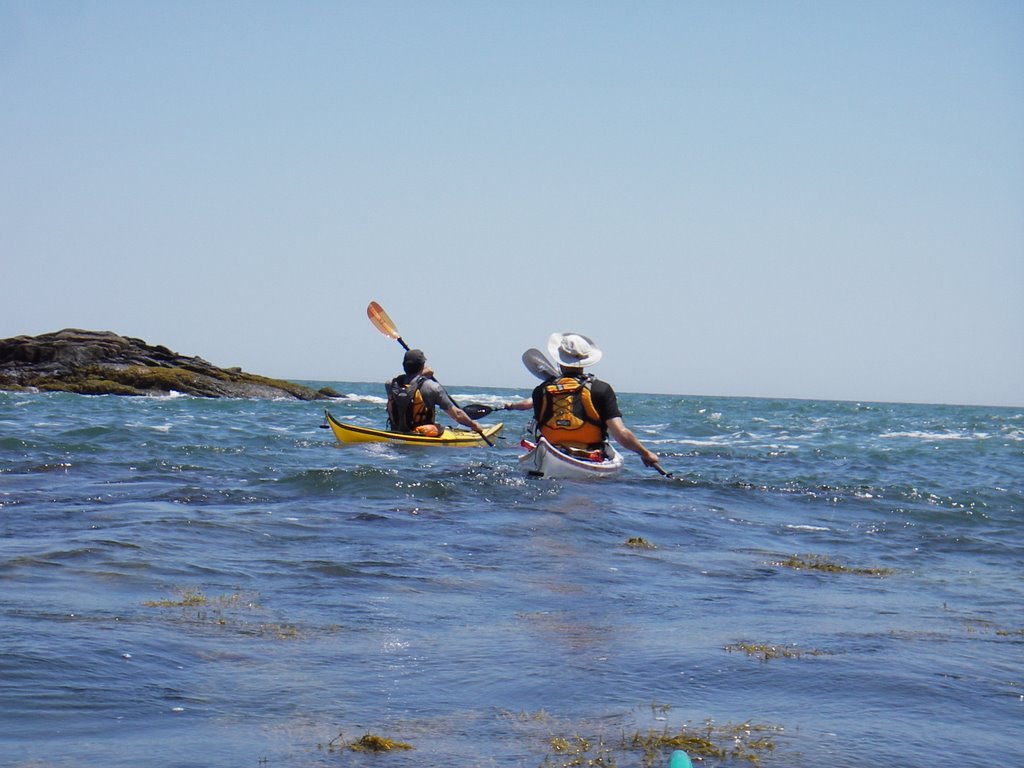 We paddled out to the Marsh whose name I forget. There was a nice wind in our faces that kept the heat at bay and the swells up. That area of the coast has a lot of interesting features that Tim M. explained to us. There are a few exposed rocks to create little breaks, but we hung pretty far out to sea. We lunched by the marsh and soaked up the sun after a few embarrassing mini-surf landings.
The launches also offered a bit of comedy. The beach was just steep enough and the surf just big enough to breach my boat before I could get the stern afloat. Finally, with a few shoves from Bob H. I did manage to get off the beach.
On the return trip, we decided to make the trip a bit more exciting. It was rock time. There is a nice big rock formation right by the beach that we played dodge the waves with a couple of times before turning homeward.
We decided to stick a little closer to shore and see if we could find any safe rocks to play around and not get our knoggins bashed.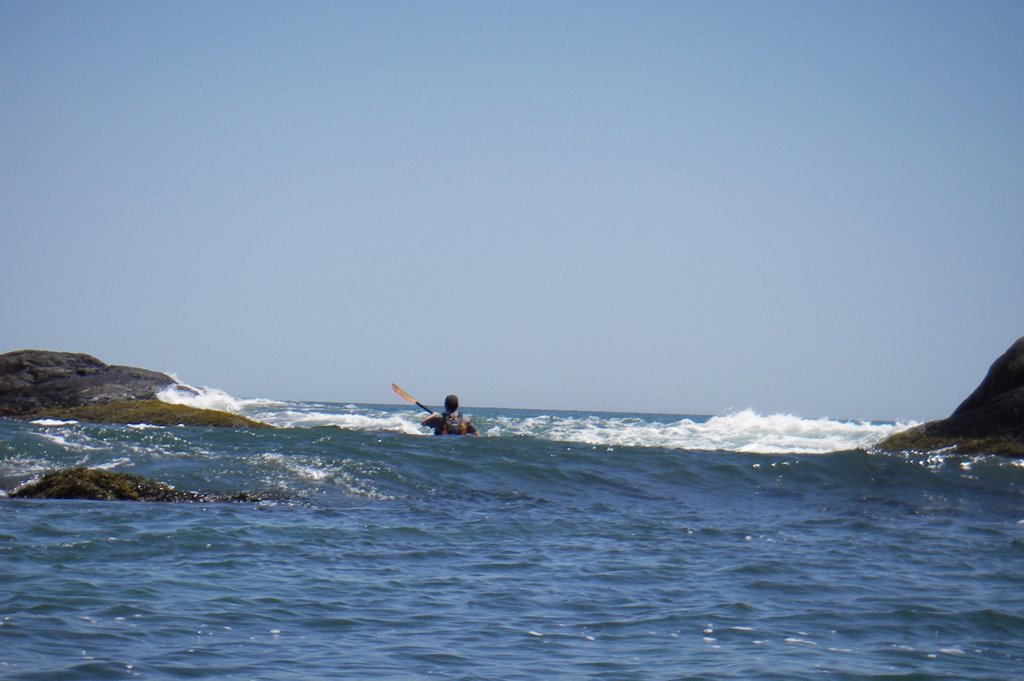 All went well until Bob went in search of a surf wave... The next thing we know there was a bright yellow spot where Bob should have been. Nobody, including Bob, knows exactly what happened, but we had a swimmer near a wave break and rocks. This is where rescue practice pays off. Bob held onto his boat and paddle; I spun around, locked up his boat and started the rescue; Paul B. clipped his tow-line into my bow and pulled us away from the rocks. In short order, Bob was out of harm's way and in his cockpit.
A bit later, I nearly got trounced by a wave. We were all trying to move outside a break and I was the innermost boat. A little wave crept up and forced a brace. Right behind it a bigger wave rolled in and took me for a ride. I managed to use my brace to stay upright and spin the boat so that I was facing down the wave. It was a roller coaster ride. While on the wave being pushed towards some rocks, I was terrified. Once safe, I was exhilarated.
We decided to test our luck once more on the rock formation just outside the mouth of the Westport River. There was a nice gap where the waves broke a little. Tim, Bob, and I all took several runs through it. Going out towards the waves was the easiest run because you could see what was coming. Going in was a rush because if you mistimed it, you could end up parked on a ridge waiting for the next wave to flip you or bash you into the rock. Tim actually got caught in the swirly on his first trip through, but held himself off the rocks.
I knew I had pushed my luck to the limit and decided to call it quits after four or five runs. It was a good thing too. While we were rounding the sea wall into the river a little breaker caught my boat just right and I had to brace in a hurry. It was definitely a sign...
The weather gods and the water gods shined on us.
Post paddle coffee was had at Tiverton Roasters--Great Coffee. The conversation was deep and thoughtful. Then the party moved to Evelyn's--a tradition reborn from its ashes--for fried sea food.
Subscribe to:
Posts (Atom)


